Wednesday, 13 February 2019

4 Types of Audit Report

There are four types of Audit Report. They are—

  1. Clean Report
  2. Qualified Report
  3. Disclaimer
  4. Negative Report
They are briefly explained as follows.

1. Clean Report

If the auditor has no reservation in respect of matters presented in the financial statements, he gives a clean report. He states that
the financial statements give a true and fair view of the state of affairs and profit and loss account during the period.

2. Qualified Report

If the auditor has any reservation in respect of the certain matters mentioned in the financial statements, he may qualify his report. The auditor may qualify his report only when the subject matter of qualification affects the truthfulness and fairness of the financial statement materially.
1. All the qualifications shall be stated by the auditor in clear and in unambiguous manner in his report.
2. Even if the subject matter of qualification is included in the notes presented by the management, which form a part of the financial statement, auditor has to repeat the subject matter of qualification again in his report clearly.
3. He shall use the word ‘Subject to‘ before stating his qualifications.
4. He shall quantify the effect of the qualifications on the financial statements as a whole as well as on individual items.
5. If the effect of qualification could not be quantified with accuracy, auditor may make an estimate on reasonable basis.

3. Disclaimer

While conducting the audit, the auditor may fail to obtain the required information and explanation or the books of accounts may not be available due to various reasons, or there may arise various situations, which shall restrict the scope of the duties of the auditor.
Under such situations, he may not be in a position to form an opinion, then the auditor shall disclaim to give an opinion.

4. Adverse/Negative Report

If the auditor is of the opinion that the financial statement does not show the true and fair view of the state of affairs of the business, he shall give an adverse or Negative Report.

Tuesday, 5 February 2019

Difference Between Misrepresentation and Mistake


A mistake is a very common occurrence in our daily lives and we tend to say sorry to others if our act of commission or omission caused any inconvenience to others. A mistake is taken as accidental error, though sometimes, especially in sports, players feel that the person committing mistakes again and again is doing them willfully. Misrepresentation on the other hand is mostly referred to in contracts where a person does not fully disclose all the facts so as to lure another party into the contract. This is also the case when a manufacturer does not tell the side effects of a product and merely harps on the benefits of the product so as to sell it in good numbers. There are other differences also between misrepresentation and mistake, which will be discussed in this article.
Sometimes the lines between a mistake and misrepresentation get blurred as when the person presenting the facts may not be in the know of true facts and may think of the facts presented by him to be correct and true. This is then an innocent misrepresentation and also a mistake on his part as he did not try to glean information from various sources. Thus an innocent misrepresentation is a mistake that can at best be termed as a felony and does not attract severe penalties. On the other hand, when misrepresentation is willful as when a person does not disclose all the facts only for monetary gains or to lure another party into signing a contract, it is considered more serious and calls for severe action against the person.
It is generally assumed that a person who is feeling sorry for his action must be pardoned for his mistake or error. On the other hand, misrepresentation, as it means hiding some information for monetary gains, is unpardonable as it may harm another person, either financially or physically.

Tuesday, 22 January 2019

Types of Business Report


Reports may be classified based on several criteria, including their use (progress reports and financial reports), purpose (informational, analytical and persuasive reports), frequency of preparation (annual, monthly, weekly and hourly reports), length (short and long reports) and whether they are internal to the business, or are used outside the business.
The most common types of business reports may be divided into the following categories –
1. Periodic reports – These are reports that are prepared on a regular basis, for both internal and external audiences. Their purpose is solely to inform. Examples of this type of report are –
a) Routine management reports – These are reports such as equipment reports and sales updates and are prepared for internal audiences.
b) Compliance reports – These are submitted to external stakeholders, such as the government, stating compliance with regulations such as environmental norms.
c) Progress reports – These reports may be prepared for both internal audiences such as top management and shareholders, as well as for external audiences such as customers. A project report stating progress on a long-term project is an example of this type of report.
2. Proposals – Unlike periodic reports, the purpose of a proposal is to persuade. Proposals may be prepared for both internal and external audiences. Examples of proposals include research proposals and marketing strategy proposals to top management, proposals to the government to grant funds for building a research facility and proposals to consumers to buy a company’s products.
3. Policies and Procedures – The purpose of these reports is solely to inform. They are also prepared only for internal audiences. Examples include reports on company policies and procedures, written by top management and sent to all employees. This is part of downward communication.
4. Situational reports – These are one-time, exceptional reports that are prepared when a unique event occurs. For example, if sales of the company has shown a significant decline, a study may be carried out to determine the reasons for declining sales and a report prepared on the findings. Similarly, a market feasibility study may be carried out before launch of a new product and a report prepared, based on the study. The purpose of such reports is usually to inform, analyze and persuade.

Barriers to communication


In the earlier section on the communication process, “noise” was mentioned as one of the elements of communication. Noise is essentially a barrier to communication and we distinguished between “physical” noise, “physiological” noise and “psychological” noise.
There are many other barriers to communication, an understanding and analysis of which are needed before coming up with ways to eliminate or minimize them. These barriers may be classified as follows –
Activity
Select any situation at your home, workplace or school/college in which you were involved. Prepare a brief summary of the communication process, using the various elements of communication discussed in this sub unit.

1. Environmental Barriers – This is the same as physical noise, which could be in the form of distracting sounds, an overcrowded room, poor facilities and acoustics, all of which may hinder the ability to listen to and understand the message.

2. Individual Barriers – A major barrier to interpersonal communication is a tendency to judge, evaluate, approve or disapprove of the views of another person. This happens particularly in situations where we have strong feelings about something. In such cases, we tend to block out the communication and form our own viewpoints.

3. Organizational Barriers – In organizations that are too hierarchical, that is, where there are multiple “layers”, messages may have to pass through many levels before they finally reach the receiver. Each level may add to, modify or completely change the message, so much so that it becomes distorted by the time it reaches the intended receiver. In other words, there is likely to be loss of meaning and the message may not reach the receiver in the same way as it was intended by the sender.

4. Channel Barriers – In the earlier section, it was pointed out that communication can fail due to any of the different elements going wrong. Wrong choice of channel is one of the main barriers to communication. Using a wrong medium of advertising, or conveying a message orally when a written letter would be more appropriate, are examples. The written channel is more appropriate when the communication is more formal or for keeping things on record, while emotional messages such as feelings about co-workers are better conveyed orally.

5. Linguistic and Cultural Barriers – When the sender of the message uses a language that the receiver does not understand, the communication will not succeed. Either the sender may be using a different or foreign language, or the language used may be too highly technical for the receiver to understand.
Linguistic barriers may also occur in cross-cultural advertising and distort the communication, when translating campaigns or slogans literally from one language to another. For example, Pepsi’s slogan “Come Alive with Pepsi”, when translated into Chinese, read “Pepsi brings your ancestors back from the grave!”
Cultural differences refer to differences in values and perceptions, which may affect the interpretation of the message by the receiver. For example, a joke about women may be taken in the wrong sense if the receiver belongs to a culture where women are highly respected.

6. Semantic Barriers – The word “semantics” refers to the meaning of words and the way in which they are used. For example, different words may have different meanings in different cultures. Failure to take this into consideration could lead to serious blunders.
Example : Saying “ The new product launch went like a bomb” in British English would mean that the new product launch was a success.
On the other hand, saying “The product launch bombed” in American English would mean that the new product was a disaster.

7. Non-verbal Barriers – This refers to the non-verbal communication that goes with a particular message. Non-verbal communication includes tone of voice, body language such as gestures and facial expressions, etc. We will be discussing this in great length in a later unit. If the tone of voice and
Business Communication Unit 1
Sikkim Manipal University Page No. 11
body language are negative, the communication will fail, however positive the spoken and written message.
For example, if you happen to meet a long lost friend and say “I am delighted to meet you”, but in a sad tone of voice, the exact opposite message will be conveyed!
Therefore, it is important to avoid giving conflicting signals, through the use of non-verbal communication.

Overcoming the Barriers to Communication
Certain steps can be taken, both at the organizational level, as well as at the individual level, to effectively deal with the barriers to communication, in order to try to minimize them, if not eliminate them entirely –
Organizational Action
1. Encourage Feedback – Organizations should try to improve the communication system by getting feedback from the messages already sent. Feedback can tell the managers whether the message has reached the receiver in the intended way or not.
2. Create a Climate of Openness – A climate of trust and openness can go a long way in removing organizational barriers to communication. All subordinates or junior employees should be allowed to air their opinions and differences without fear of being penalized.
3. Use Multiple Channels of Communication – Organizations should encourage the use of multiple channels of communication, in order to make sure that messages reach the intended receivers without fail. This means using a combination of both oral and written channels, as well as formal (official) and informal (unofficial) channels of communication. The types of channels will be discussed in detail later, in a separate unit.
Individual Action
1. Active Listening – This means listening to the meaning of the speaker’s words, rather than listening without hearing, or “passive listening”. Passive listening is a barrier to communication, whereas real communication takes place when we listen actively, with understanding. Listening is a skill which can be developed through proper training.
2. Careful wording of messages – Messages should be worded clearly and without ambiguity, to make sure that the message that is received is the same as the message that is sent.
3. Selection of Appropriate Channels – Individuals should be competent enough to choose the right communication channel, depending on the situation. Channels of communication and the criteria for selection of channels will be discussed in detail in a later chapter.

Communication Network in Business organization


A communication network refers to how information flows within the organization. Information within an organization generally flows through a system, rather than being a free flow. In the words of Adler, “Communication networks are regular patterns of person-to-person relationships through which information flows in an organization.”
This means that the flow of information is managed, regulated. and structured.
Communication networks may be formal or informal. We will deal with each of these in some detail.
Formal Communication Network – A formal communication network is one which is created by management and described with the help of an organizational chart. An organizational chart specifies the hierarchy and the reporting system in the organization. Therefore, in a formal network, information is passed on only through official channels such as memos, bulletins and intranet (email within the organization).
The organizational chart implies that information can flow in any of three directions – vertically, i.e., upward or downward, and horizontally.
1. Upward Communication – This may be defined as information that flows from subordinates to superiors. Some of the reasons for upward communication include discussing work related problems, giving suggestions for improvement and sharing feelings about the job and co-workers.
This type of communication has both benefits and disadvantages. One of the biggest benefits is problem-solving. Once a subordinate has brought a problem to his superior’s notice, chances are that the problem will not recur, since the subordinate learns from his superior how to tackle it the next time. Thus, his ability to solve new problems and therefore his managerial ability, improves. Another benefit that could arise from upward communication is that valuable ideas and suggestions may sometimes come from lower level employees. Therefore organizations should encourage this kind of communication.
A third benefit is that employees learn to accept the decisions of management and thereby work as a team.
The biggest problem associated with this type of communication is that it may lead to “handing down” of decisions by superiors. When subordinates frequently seek the superior’s guidance, the latter may adopt an authoritarian approach and merely give instructions, disregarding the subordinate’s opinion completely.
2. Downward Communication – This may be defined as information that flows from superiors to subordinates. The most common reasons for downward communication are for giving job instructions, explaining company rules, policies and procedures and giving feedback regarding job performance. A number of studies have indicated that regular downward communication in the form of feedback given to employees is the most important factor affecting job satisfaction. Therefore organizations today are trying to encourage more of this type of communication.
There are both benefits and disadvantages associated with this type of communication. Downward communication that provides regular feedback will be beneficial if the feedback or review of performance is constructive. A constructive review is one where a manager “counsels” an employee, or advises him on how to improve his performance. On the other hand, a destructive review can destroy employee morale and confidence. Regular downward communication also creates a climate of transparency or openness, where information is passed on through official channels, rather than through rumors.
Thirdly, downward communication boosts employee morale, since it indicates that management is involved in their progress.
The problems with this type of communication are the danger of doing destructive reviews, as mentioned, and that of “message overload.” This means that superiors many sometimes burden their subordinates with too many instructions, leading to confusion.
3. Horizontal Communication – This type of communication is also known as “lateral” communication. It may be defined as communication that takes place between co-workers in the same department, or in different departments, with different areas of responsibility. For example, Sales Managers and Advertising Managers in the Marketing department, or Marketing Managers and Finance Managers.
The reasons for this type of communication are for coordination of tasks, sharing of information regarding goals of the organization, resolving interpersonal or work related problems and building rapport.
The biggest potential benefit of horizontal communication is the sense of teamwork that is created. Regular communication of this type ensures that all co-workers work together towards achieving a common goal in the overall interest of the organization. The biggest potential problem is that conflicts such as ego clashes are bound to arise, when co-workers at the same level communicate on a regular basis.
In spite of these problems, horizontal or lateral communication has become more important in today’s business scenario than upward or downward communication. This is because the “organizational pyramid” indicating the different hierarchies or levels in an organization has flattened. This is illustrated by the diagrams given below.

Informal Communication Network – Another name for informal networks is the “grapevine”. In this type of network, information does not flow in a particular direction, as we have seen with formal networks. The information is also not passed on through official channels such as memos, notices or bulletin boards. The information need not be circulated within the organization, but could be passed on outside the work environment, wherever co-workers or colleagues meet socially. Thus, informal networks are based more on friendship, shared personal or career interests.
Example – Co-workers may meet outside the work environment at a company picnic, party or a car pool and discuss areas of common interest that may or may not be work related. Information may then be passed on to each other about happenings in the company, such as layoffs, the company’s plans for acquisitions and so on.
This type of informal network is not just for idle rumors and may be useful in many ways. First of all, it sometimes fills in the “transparency gaps” left by formal networks. Such gaps usually occur during times of crisis such as strikes or layoffs. The strikes and layoffs may not be officially announced. Secondly, it may help to confirm important information, such as the fact that the company is going in for a major acquisition. Thirdly, the grapevine can be used for a constructive purpose by the organization.
Example – The government could get the press to publish news in the local paper that there is going to be a petrol price hike soon, just to test the reactions of the general public. If the reaction is negative, then the news may be withdrawn on the basis that it is just a rumor. Similarly, organizations could deliberately plant proposals in the minds of their employees, just to test their reactions.
Given that informal communication networks have their advantages, they should not be suppressed as rumors. On the contrary, competent managers should accept the informal network. At the same time, they should make efforts to counter false rumors and to ensure transparency through the formal network. This means making all types of information - both positive and negative, available to everyone in the organization through official channels.
To conclude, it should be remembered that both formal and informal networks should be cultivated and allowed to co-exist, so that information of all types flows freely to all levels in the organization.

Saturday, 29 December 2018

Maslow’s theory of motivation

Image result for maslow's hierarchy of needs
Maslow’s need priority model is one of the most widely referred to theories of motivation. Abraham Maslow, a clinical psychologist, thought (1943) that a person’s motivational needs could be arranged in a hierarchical manner, starting in an ascending order from the lowest to the highest needs and concluded that once a given level of needs (set of needs) was satisfied, if ceased to be a motivator. The next higher level of need to be motivated in order to motivate the individual. Although the hierarchical aspects of Maslow’s theory are subject to question and often not accepted, his identification of basic needs has been fairly popular.
The five categories of needs may be described as follows:

1. Physiological NeedsThese are the basic needs for sustaining human life itself: needs for food, drink, shelter, clothing, sleep, sex etc. Man can live on bread alone, if there is no bread. But once these basic needs are satisfied, they no longer motivate.
2. Safety NeedsSafety or securing needs are concerned with freedom from physical or psychological (mental) harm, danger, deprivation or threat, such as loss of jobs, property, food, clothing or shelter.
3. Social Or Affiliation Or Acceptance NeedsThese are belongingness needs emanating from human instinct of affiliation or association with others. These include owners, love and affection, needs of mutual relations, identification with some group etc. These are the needs more of mind and spirit than of physique.
4. Esteem NeedsThis set of needs represents higher level needs. These needs represent needs for self-respect, respect of others a general feeling of being worthwhile, competence, achievement, knowledge, independence, reputation, status and recognition.
5. Self-Actualization NeedsThis set of higher order needs concerns with reaching one’s potential as a total human being. It is the desire to become what one is capable of becoming, i.e. to maximum one’s capacity and abilities in order to accomplish something appreciable and self-fulfilling. It is a need for being creative or innovative, for transforming self into reality

Various definitions of Management

ManagementIt is very difficult to give a precise definition of the term management. Different management authors have viewed management from their own angles moreover, during the evolutionary process of management different thinkers laid emphasis on different expects. For example, F.W. Taylor emphasized engineering aspects, Elton Mayo laid emphasis on human relations aspects, E.F.L, Brech, George R. Terry emphasis on, decision making aspect, Ralph Davis stresses leadership aspect and some other like Barry Richman etc. emphasized integration or coordination aspect.
Some Important Definition of Management
1. Harold KoontzManagement is the art of getting things done through and with people in formally organized groups.
2. George R. TerryManagement is a disconnect process consisting of planning organizing activating and controlling performed to determine and accomplish the objectives by the use of people and resources.
3. Donald J. CoughManagement is the art and science of decision making and leadership.
4. Mary Cushing NileGood Management, or scientific management, achieves a social objective with the best use of human and material energy and time, and with satisfaction for the participants and the public.
5. Henry FayolTo manage is to forecast, to plan, to organize, to command, to coordinate, and to control.
6. Theo Haimann and William ScottManagement is a social and technical process which utilizes, resources, influences, human action and facilitates changes in order to accomplish organizatinal goals.
Thus, the above definitions bring out that
  • Management us a social and technical process
  • It consists of planning, organizing staffing, leading decision making coordinating and controlling.
  • It is concerned with getting done i.e. accomplished pre-determined objective by the use of people and resources.
  • It helps in the creation, direction, maintenance and operation of organization.
  • It secures maximum benefits for the employer, the employees, and the community.

Monday, 17 December 2018

Unfair Labour practices

Related image

Unfair Labour practices on the part of workmen: 

It has been defined in section 64 of the Ordinance which is given below:
 No workman or trade union of workmen shall:
(a) persuade a workman to join or refrain from joining a trade union during working hours; or
(b) intimidate any person to become, or refrain from becoming, or to continue to be or to cease to be a member or office-bearer of a trade union; or
(c) induce any person to refrain from becoming, or cease to be a member or office-bearer of a trade union by intimidating or conferring or offering to confer any advantage on or by procuring or offering to confer any advantage on or by procuring or offering to procure any advantage for such person or any other person; or
(d) compel or attempt to compel the employer to accept any demand by using intimidation, coercion, pressure, threat, confinement or ouster from a place, dispossession, assault, physical injury, disconnection of telephone, water or power facilities or by such other methods; or
(e) compel or attempt to compel any member of a body, bipartite or tripartite or of any composition, relating to the functioning of the industry or is in place for the benefit of workers, to accept any demand by using intimidation, coercion, pressure, threat, confinement or ouster from a place, dispossession, assault, physical injury or by such other methods; or
(f) commence, continue, instigate or incite others to take part in or expend or supply money or otherwise act in furtherance or support of an illegal strike or adopt go- slow measures; or
(g) carry any arms or weapons within the premises of an employer without any legal authority.

Unfair Labour practices on the part of employer: 

It has been defined in section 63of the Ordinance which is given below:
 No employer shall:
(a) impose any condition in a contract of employment seeking to restrain the rights of a person who is a party to such contract to join a trade union or continue his membership of a trade union; or
(b) refuse to employ or refuse to continue to employ any person on the ground that such person is or is not, a member or office-bearer of a trade union; or
(c) discriminate against any person in regard to any employment, promotion, condition of employment or working condition on the ground that such person is or is not, a member or office-bearer of a trade union; or
(d) dismiss, discharge, remove from employment or transfer a workman or injure him in respect of his employment by reason that the workman- (i) is or proposes to become a member or office-bearer of a trade union; or (ii) participates in the promotion, formation or activities of a trade union;
(e) induce any person to refrain from becoming, or to cease to be a member or office-bearer of a trade union, by conferring or offering to confer any advantage on, or by procuring or offering to procure any advantage for such person or any other person; or
(f) compel or attempt to compel any office-bearer of a collective bargaining agent to arrive at a settlement by using intimidation, coercion, pressure, threat, confinement to a place, physical injury, disconnection of water, power or telephone facilities or by such other methods; or
(g) interfere with or in any way influence the balloting provided for in section 20; or
(h) recruit any workman during the period of notice of strike under section 31 or during the currency of a strike which is not illegal except where the Conciliator has, being satisfied that complete cessation of work is likely to cause serious damage to the machinery or installations, permitted temporary employment of a limited number of workmen in the section where the damage is likely to occur; or
(i) close down the whole of an establishment in contravention of Standing Order 11A of the West Pakistan Industrial and Commercial Employment (Standing Orders) Ordinance, 1969 (West Pakistan Ordinance No VI of 1968); or (j) commence, continue, instigate or incite others to take part in, or expend or supply money or otherwise act in furtherance or support of an illegal lock-out.


Saturday, 24 November 2018

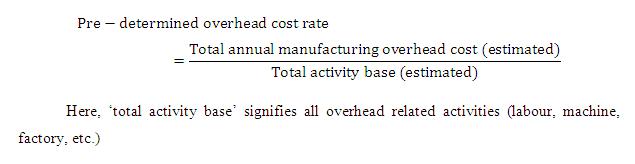
Five basis used for calculating predetermined factory overhead rates

Related image

FOH predetermined rate is calculate on five bases which are as follows:

  1. Materials costs
  2. Direct labor cost
  3. Direct labor hours
  4. Machine hours
  5. Units of production


  1. Materials costs:

                                  We can calculate predetermined FOH rate on the bases of materials cost by the following formula:

                       Predetermined FOH rate= Estimated FOH ×100
                                                                          Materials cost

  1. Direct labor cost:
                                    We can calculate FOH predetermined rate on the bases of direct labor cost, the formula is:

                           Predetermined FOH rate= Estimated FOH ×100
                                                                         Direct labor cost


  1. Direct labor hours:
                                        If we calculate FOH rate predetermined on the bases of direct labor hours. The formula is:

                          Predetermined FOH rate= Estimated FOH 
                                                                         Direct labor hours


  1. Machine hours:
                                        If we calculate FOH rate predetermined on the bases of machine  hours. The formula is:

                          Predetermined FOH rate= Estimated FOH 
                                                                           Machine hours


  1. Units of Production:
                                        If we calculate FOH rate predetermined on the bases of Units of production. The formula is:

                          Predetermined FOH rate= Estimated FOH 
                                                             

                                                                     Units of production


4 Types of Audit Report

There are four types of  Audit Report . They are— Clean Report Qualified Report Disclaimer Negative Report They are briefly explai...